1.
Adeolu Joshua Ayeni
Abstract-The study examined principals' decision making strategies and level of teachers' involvement in decision making, and determined the implications on teachers' instructional task performance and students' academic performance in secondary schools in Ondo Central Senatorial District of Ondo State, Nigeria. Four research questions were raised, and two hypotheses were also formulated to guide the study. Descriptive survey and ex post facto research designs were adopted. Respondents comprised 30 principals and 600 teachers randomly sampled from 30 secondary schools. Data were collected using "Principals' Decision Making and Teachers' Task Questionnaire" (PDMTTQ), and "Students' Academic Performance Proforma" (SAPP). Research questions were analyzed using frequency count and percentage while hypotheses were tested using the Pearson Product Moment Correlation Coefficient at an alpha level of 0.05. Results showed the significant relationship between principals' decision making strategies and teachers' instructional task performance (r-cal=0.528, p<=0.000), and significant relationship between teachers' instructional task performance and students' academic performance (r-cal=0.511, p<=0.000). Principals' decision making strategies were effective in policy awareness (80%), committee system (53.4%), delegated authority (50%) and departmental feedback (56.7%), and fairly effective in corporate goal setting (40%), group needs (40%), open discussion (46.6%), constructive criticism (43.3%) and corporate evaluation (46.7%). Teachers were effective in classroom management (65.8%), curriculum planning (51.9%), learners' assessment (73.7%), goals attainment (54.3%), and fairly effective in resource utilisation (49.4%) and innovation (48.5%). However, decision making strategies were least effective in capacity development (33%), problem identification (38.1%), budgeting (23.5%) and time management (25.9%). Based on the findings, it was concluded that teachers should be given more opportunities in decision making and more training opportunities should be organized to improve principals' capacities in decision making for the enhancement of teachers' productivity in secondary schools.
2. I. Introduction
he secondary school is a formal organization that is established to achieve educational goals (Prepare students for higher education and useful living) through teaching and learning activities (The Federal Republic of Nigeria, 2013). This underscores the value placed on the process of decision-making by the school principals and other top management members (Vice principals, heads of departments, subject heads, heads of committees, and class coordinators). The tasks involved are goal setting, deployment and coordination of human and material resources for effective curriculum planning, implementation, evaluation and review of both learning and administrative activities in order to achieve the set educational goals in secondary schools.
The task of making a decision in educational practice is very important because of the need to improve the quality of interaction among the teaching and learning resource elements. This includes teacherteacher interaction, teacher-learners' interaction, learnerlearner interaction, teacher-material interaction, and learner-material interaction in the school system. The interactive actions also require adjustment and modification of educational programmes, activities and techniques for the purpose of improving the teachinglearning process and achieve the set educational goals in secondary schools.
Decision-making is the process of selecting the best/most preferred and workable action among other options or alternative courses of action available, either towards solving problems or the achievement of an objective. Decision-making is a sequential process ending in a single decision or series of decisions (choices) which stimulate or cause some actions. Effective teaching and learning activities can only occur in an enabling environment where the principal possesses a high level of imagination, initiative, vision, and techniques in making a decision (Duze, 2011). Since the school is made up of the principal, teachers, and students, and by extension, many other stakeholders who are committed towards the progress of the school; significantly, the extents to which teachers are involved in decision-making determine the level of their commitment to instructional tasks performance and students' academic achievement.
Teachers' productivity is the rate or extent to which teachers meet or achieve expected goals. Observably, the quality of teachers' instructional task performance is enhanced by their level of awareness and involvement in decision making process. Teachers are motivated when they are given sense of belonging in decision making and they perform their instructional tasks with enthusiasm, without being compelled, with less monitoring, and they are highly innovative, creative and imaginative in the application of teaching methods to achieve quality learning outcome. The rationale for teachers' participation in school decision making is to facilitate better decisions, because teachers are the closest to the students and they know best how to improve their performance (Cheng, 2008).
However, teachers' productivity could be undermined with maginalisation; excess workload and irregular payment of salaries often lead to low morale and dissatisfaction on the job which ultimately results to low achievement for the learners. In a bid to make quality decisions, principals must carry teachers along by adopting collaborative and participatory decisionmaking strategies that will encourage teachers' inputs and commitment to the implementation of curricula and co-curricula programmes/activities and attainment of the set goals in secondary schools.
3. II. Theoretical Framework
The theoretical framework for this study is based on the Path-goal theory by House (1971) that stipulated that both leaders (principals) and subordinates (teachers) should involve themselves in decision making if the organization is to achieve its goals. He added that when goals are set together, the subordinates (teachers) become committed; selfconfident and knowledgeable about the set goals thus making them perform well. Glueck (2006) also stated that when educational managers (principals) engaged in thoughtful deliberations with their subordinates (teachers), there is greater opportunity of the expression of mind and ideas which lead to quality decisions. It is wisely said that "Two heads are better than one". This means that when two or more people sit and try solving a problem together, they are able to make better decisions than one person. Oduro (2004) described quality decision as the product of shared leadership, collective actions, mutual trust, openness and consultation. This implied that problem-solving is impossible with single person's competence and wisdom. This underscores the importance of participative management as means to motivate employees by considering their suggestions and group efforts, which certainly can have positive impact on teamwork and employees' job performance.
4. a) Concept of Decision-Making
Decision-making has been defined differently by various authors focusing primarily on the process involved in choosing the best option among alternatives. Duze (2011) described decision making as the process by which educational managers (principals) choose the best action or most preferred course of action among alternative sources of action with the purpose of solving problem and achieving set goals effectively and efficiently. Therefore, the principal who manages secondary school should have deep and expert knowledge of decision making in coordinating individuals or group members in specifying the nature of particular problem and selecting among available alternatives in order to solve the problem and produce a desired result.
Decision making begins with identifying a problem, mapping out activities and implementation strategies in needed time. The process involves participatory planning, participatory implementation, evaluation and feedback. Decision making process also involves policies (the definition of objectives), resources (people, money, materials and authority), and means of execution (strategies). In the school setting, the content value of decision making process is concerned with the ability of the school principal to be able to identify policy decision that seeks purposeful action; and executing decision that ensures the best coordination of actions.
The success of any organization such as the educational institution depends largely on the ability of the educational manager to make effective decisions. This is why Oviwigbo (2004) stated that principals need to give considerable attention to key elements of managerial process: planning, organising, staffing, directing, coordinating, reporting, and budgeting in making decisions (POSDCORB). Decisions are made daily in school about the individuals' roles, conduct of work, distribution of resources, and short term goals. Decision making usually involves what is to be done, how is to be done, who to do it, and when and where is to be done. In a school organization, principal has to make decisions that enable the organization to Productivity in an organization is the ability to do the right thing (effectiveness) and do something well or achieves a desired result without wasted effort (efficiency). Both the employees and other resources must be properly managed and all priorities must be placed in order of their importance in order to achieve the set targets within the stipulated time -frame. Productivity is the result achieved from output over input; it is the optimal utilization of existing resources to meet the set targets. Productivity reduces wastages and brings about sustainable quality through proper harnessing of work efforts using different methods such as shared responsibility, team work, capacity building and motivation to induce workers to realize the organization's objectives.
5. Global Journal of Management and Business Research
Volume XVIII Issue X Version I Year ( ) achieve its goals and meet the critical needs of members of the organization.
6. b) Decision Making Process in Secondary School
Donnelly, Gibson and Mancervich, (1995) described decision as a means rather than ends in itself. It is the process by which the school principal addresses issues dealing with curriculum instruction, supervision, evaluation, and personnel and students' administration, public relations, negotiation and compromise with both members within and outside the school in order to achieve the set goals (Musaazi, 1992).
The school principal is the driving force in decision making process. This requires active involvement of teachers in corporate goal setting in staff meetings, committees and delegation of authority to carry out certain activities and responsibilities. These platforms enable teachers to collaborate, discuss and share ideas because the school is an organisation made up of people whose knowledge, skills and experience complement each other. This approach will no doubt improve the quality of decisions, boost performance and accelerate achievement of the set goals in secondary schools.
According to Donnelly, Gibson and Mancervich (1995), the specific stages/steps that contribute to high quality decision making process are identified in the diagram below. This occurs when there is a sudden change in established patterns of performance, decline in students' enrollment, poor performance in external examinations, frequent changes in leadership, style of leadership, poor teachers' motivation, and inappropriate supervision of the teaching-learning process. 2) Deviation from objectives manifest in form of lack of corporate interest, unscheduled activities and poor supervision. This means that administrator is ignoring the best interest of the organization in decision making process.
3) Outside Criticisms: This occurs when the members of the community and the Parents Teachers Association expressed dissatisfaction on teachers' lukewarm attitude to work and low academic performance of students. This reaction often leads to withdraw of support and agitation for a change in leadership.
ii Developing Alternatives It is imperative for the school principal to be proactive in making consultation with relevant stakeholders in taking timely decisions whenever problems are identified. When problems are defined, potential solutions to the problems are equally developed with the consequences of each alternative being carefully considered internally and externally in order to adopt the best alternative decision. iii Evaluating Alternatives This involves the formulation of objectives for the alternative solutions and setting the time-frame that produces the most favourable outcomes within conditions of certainty and uncertainty. Decision making could be under certainty (each alternative lead to a goal or consequence), risk (each alternative has one or more consequence and the probability of each are known) and uncertainty (each alternative lead to one or more consequence with an unknown probability). The school principal must have complete knowledge about the risk involved (negative or positive) and consequences of each alternative preferred to solve a problem. However, when decisions are made, most school principals anticipate positive results in most cases (Donnelly, Gibson & Mancervich, 1995).
7. iv Choosing Alternatives
The purpose of decision making is to achieve predetermined objectives in an organization. Therefore, the school principal is expected to think about the cost benefit analysis and channel decision towards the alternative that meet acceptable standards, minimize wastage and achieve the set objectives within a specific time-frame with minimal cost, risks and consequences based on the evaluated alternatives.
v
8. Implementing the Decisions
The decision making process is not complete until it is implemented since the essence of any decision is to secure action and achieve the set objectives. Therefore, decision maker has to seek and obtain the willingness, cooperation and acceptance of the preferred alternative by all involved to ensure effective implementation of decisions. It is expedient of the school principals to employ effective communication, motivation of teachers and proper timing of events, and pointing out the advantages of the preferred alternative without any bias and prejudice to suggestions made by the committees. This approach facilitates easy and effective coordination of teachers' activities in the implementation of decision. However, inadequate involvement or exclusion of people concerned in decision making process can undermine the achievement of the set objectives.
vi Control and Evaluation of Decisions Effective decision making process deals with the coordination of both human and material resources. This is built on the principle that effective school administration involves a periodic assessment of teachers' tasks and students' performance. This is done to check deviations and distortions to the stated objectives. It is therefore an important task of the school principal to assess how, when and extent to which decisions and functions are performed by teachers while the feedback received is also used to ensure effective control in order to achieve the stated objectives.
9. c) Decision Making Strategies
Decision is crucial to the realization of organization objectives. Decisions can be better facilitated when all members of an organization, irrespective of age, qualification, and experience participate in decision making process. This is an indication that problems are better solved when two or more individuals brainstorm on them. According to Bernard (2002) principals should know that teachers are reliable instruments in implementing administrative policies through their involvement and participation in decision making process. Teachers feel highly motivated when they are consulted about decisions that concern their work.
The school being a dynamic social system is made up of different elements including people who have varied knowledge, skills and experience that are required for effective administration and implementation of the curriculum. It is expected that the school principals operate 'open door policy' and welcome ideas from all teachers during a brainstorming session at the staff meetings in order to generate, evaluate and choose the best among alternative ways of providing solution to the identified problem.
According to Mullins (2004), staff participation in decision making leads to higher performance. Wilkinso (1999) corroborated this fact and saw involvement of employees in decision making as empowerment of workers with knowledge, skills and experience while the neglect of employees in decision making was seen as an assumption that workers are untapped resources. Therefore, school principals need to provide opportunities and structures for teachers' involvement in decision making process to enhance effective job performance.
Wilkinson further assumed that participating in decision making is likely to lead to job satisfaction, better quality decisions and increased efficiency. In contrast, where teachers lack motivation and involvement in decision making, there are usually cases of truancy, excessive excuses, absenteeism and complaints. These inadequacies usually culminate in general ineffectiveness, inefficiency, low productivity and non-achievement of organizational goals.
10. d) Statement of the Problem
Decision making in secondary schools is increasingly becoming complex because of the challenges of increased enrolment, congested classrooms, inadequate learning materials, poor funding, low staff strength and demands for quality instruction and better learning outcome by the stakeholders in education. However, it is only through a shared decision making process that effective implementation of school curriculum and achievement of the set goals can be assured. It is not uncommon that many school principals often dominate school affairs
11. Global Journal of Management and Business Research
Volume XVIII Issue X Version I Year ( ) A and give little or no regard to teachers' involvement in decision making process. The common slogan is "wait for your time", which has partly caused teachers' disenchantment in instructional tasks and resulted in low academic performance of students in public secondary schools.
The weighted average of the percentage level of performance of students who obtained credit level passes in five subjects and above, including English Language and Mathematics in the Senior School Certificate Examination conducted by the West African Examinations Council (WASSCE) between 2012 and 2016 is still below average (43.32%) in Ondo State secondary schools (Ministry of Education, 2017). This has been a source of concern for the stakeholders in education. The low academic performance indicates a gap in curriculum implementation and the perceived inadequacies in decision making strategies adopted by the school principals. It is therefore necessary to investigate the extent to which principals' decision making strategies impact teachers' instructional tasks and students' academic performance in public secondary schools in Ondo Central Senatorial District of Ondo State, Nigeria.
12. e) Research Questions
The following research questions were raised to guide the study.
13. f) Research Hypotheses
The following hypotheses were formulated to guide the study. Ho 1 : There is no significant relationship between principals' decision making strategies and teachers' instructional task performance in secondary schools in Ondo Central Senatorial District of Ondo State.
Ho 2 : There is no significant relationship between teachers' instructional tasks and students' academic performance in secondary schools in Ondo Central Senatorial District of Ondo State.
14. III. Research Method
The study adopted the descriptive survey and ex post facto research designs. Multi-stage sampling technique was used to select two (2) Local Government Areas out of the six (6) Local Government Areas in Ondo Central Senatorial District of Ondo State. Respondents comprised 30 principals and 600 teachers randomly sampled from 30 secondary schools. Four research questions were raised and two hypotheses were also formulated. Data were collected using "Principals' Decision Making and Teachers' Task Questionnaire" (PDMTTQ), and "Students' Academic Performance Proforma" (SAPP). The instrument utilized a five-point Likert rating scale classified as Strongly Agree (SA), Agree (A), Fairly Agree (FA), Disagree (D) and Strongly Disagree (SD) with value of 5, 4, 3, 2 and 1 respectively.
The instruments covered decision making variables such as collective responsibility, committee system, open discussion, problem identification, policy implementation, resource allocation and utilization, capacity development, motivation, time management, performance evaluation, feedback and review. Students' learning outcome variable is the academic performance in the Senior School Certificate Examinations conducted by the West African Examinations Council (WAEC).
The research instrument was validated by experts in the Department of Educational Management, Faculty of Education, Adekunle Ajasin University, Akungba-Akoko and Test and Measurement Unit, Faculty of Education, Obafemi Awolowo University, Ile-Ife, Nigeria. The reliability of the instrument was confirmed through test and re-test of the instrument at two weeks interval in two schools outside the Local Government Areas of the study. This yielded a correlation co-efficient of 0.82 that indicated high reliability of the questionnaire items constructed.
The researcher was assisted by two trained research assistants who helped in the administration of questionnaires in the sampled schools while completed questionnaires were collected from the respondents on the same day. The few respondents who could not fill the questionnaire on the spot were given opportunity till the next day when the researcher visited their schools to collect completed questionnaire. The administration of the instrument took five (5) working days. This method ensured 100% rate of return of the questionnaire. Data were analyzed using frequency count, percentage and Pearson Product Moment Correlation Coefficient to determine the strength of relationship between independent and dependent variables. The result was held significant at 0.05 levels, using Statistical Package for Social Sciences (SPSS) version 20.0.
15. IV. Results
The results and discussions of data analyses are presented in two parts based on the research questions and hypotheses that were formulated for the study. Data collected on research questions were analysed using frequency count and percentage while hypotheses were tested at 0.05 level of significance
16. Global Journal of Management and Business Research
Volume XVIII Issue X Version I Year ( ) A using Pearson Product Moment Correlation Coefficient (PPMCC). The results are presented in tables 1 -6.
17. a) What strategies are adopted by principals in decision making process in secondary schools
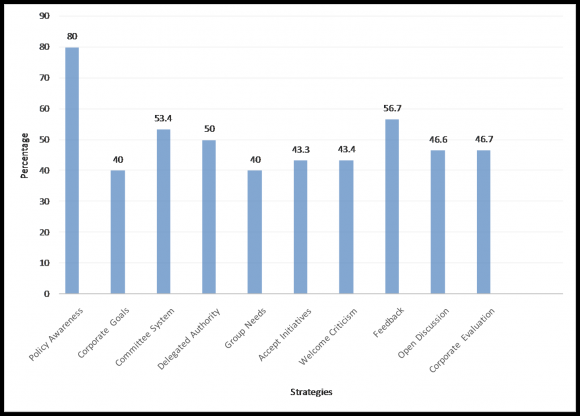
The analysis of data in table 1 and figure 1 on strategies that are adopted by principals in decision making indicated that an average number of principals were effective as reflected in the following percentage points: policy awareness (80%), committee system (53.4%), delegated authority (50%), feedback (56.7%), open discussion (46.6%) and corporate evaluation (46.7%). These were reflected in percentage points of strongly agree and agree responses combined in items 3, 4, 5, 6, 8 and 9. Create awareness for policy implementation procedures. The analysis of data in table 2 and figure 2 indicated that an average number of teachers were effectively involved in decision making process as reflected in the following percentage points: personal suggestions (44.9%), examination planning (89.9%), examination supervision (89.7%), committee involvement (53.5%) and instructional review (49.6%). These were reflected in percentage points of strongly agree and agree responses combined in items 4, 5, 6, 9 and 10.
18. c) How does decision making affect teachers' tasks performance in secondary schools?
The analysis of data in table 3 and figure 3 indicated that majority of teachers were effective in tasks performance as reflected in the following percentage points: classroom management (65.8%), curriculum planning (51.9%), teaching learning process (84.4%), learners' assessment (73.7%), goals attainment (54.3%), job commitment (73.8%), resource utilization (49.4%), instructional review (54.8%) and innovation (48.5%). These were reflected in percentage points of strongly agree and agree responses combined, which ranged from 48. 5 Data presented in tables 4, showed weighted average and analysis of students' academic performance for three academic sessions (2014 -2016). The result indicated that 46.81% of the candidates met the baseline standard (obtained five credits and above, including English Language and Mathematics). This implied that the level of students' academic performance is still below average in secondary schools in Ondo State. A comparative analysis of results indicated that the best academic performance was recorded in year 2016 (Mean=4.48). The result revealed that the calculated r-value (0.528) was greater than the critical-value (0.000) at p<0.05 is significant. Hence, the null hypothesis (Ho) of no significant relationship is rejected. This implied that there is a significant relationship between principals' decision making strategies and teachers' instructional tasks in secondary schools. The result revealed that the calculated r-value (0.511) was greater than the critical-value (0.000) at p<0.05 is significant. Hence, the null hypothesis (Ho) of no significant relationship is rejected. This implied that there is a significant relationship between teachers' instructional tasks and students' academic performance in secondary schools.
19. V. Discussions
The ratings of secondary school principals' decision making strategies by teachers in table 1 indicated that principals were effective in strategies such as the policy awareness (80%), committee system (53.4%), delegated authority (50%) and departmental feedback (56.7%). This implied that an average number of principals allowed sharing of ideas among teachers and carried them along in school administration. This finding was supported by Glueck (2006) that when educational managers (principals) engaged in thoughtful deliberations with active participation of their subordinates (teachers), there is greater opportunity of the expression of mind, ideas, quick resolution of disputes and agreement which lead to quality decisions and greater achievement of the set goals.
The analysis of data in table 1 also showed that principals were fairly effective in corporate goal setting (40%), group needs (40%), open discussion (46.6%), constructive criticism (43.3%) and corporate evaluation (46.7%). The shortcoming in these critical areas of school administration could limit teachers' knowledge, pedagogical skills and experience in curriculum delivery which depends largely on the quality of principals' professional and administrative leadership. When teachers are restricted from active participation in any matter in the school, it affects their level of commitment
20. Global Journal of Management and Business Research
Volume XVIII Issue X Version I Year ( )
21. A
22. Candidates
with less than Five (5) Credits (2) to instructional tasks and ultimately lower students' academic performance. This has possibly been responsible for the relatively low level of success recorded in the weighted average of 46.81% on students' academic performance in WASSCE between 2014 and 2016 academic sessions.
The level of teachers' involvement in decision making on table 2 revealed that teachers were effectively involved in examination planning (89.9%), examination supervision (89.7%), committee system (53.5%), and fairly involved in problem identification (38.1%), personal suggestions (44.9%) and instructional review (49.6%). A cursory look at the findings in table 2 indicated that an average number of principals involved teachers in decision making. This has perhaps been responsible for the relatively low level of 46.81% recorded on the performance of candidates who met the baseline standard (obtained five credits and above, including English Language and Mathematics in WASSCE) between 2014 and 2016. It could therefore be inferred that principals do not have all the ideas as far as school administration is concerned; the low level of teachers' involvement in problem identification, personal suggestions and instructional review could impede success in school administration, curriculum delivery and students' academic performance. This is why teachers need to be adequately involved in decision making process in order to improve the quality of decisions and contributions to the actualization of the set goals.
The analysis of data in table 3 indicated that majority of teachers were effective in instructional tasks as reflected in the level of effectiveness recorded in classroom management (65.8%), curriculum planning (51.9%), teaching-learning process (84.4%), learners' assessment (73.7%), goals attainment (54.3%), job commitment (73.8%), curriculum evaluation (54.8%), and fairly effective in resource utilization (49.4%), and innovation (48.5%). Teachers are motivated to give their best whenever their opinions are sought and ideas are implemented in school programmes and activities. The finding by Wilkinson (1991) corroborated this fact that teachers who are adequately involved in decision making process have job satisfaction and demonstrate strong commitment to quality service delivery and adequate support for the realization of the set goals while teachers who are marginalized in decision making usually engaged in truancy, absenteeism, unnecessary complaints, apathy and opposition within the school (Awotua-Efebo, 1999).
Analysis of data on table 5 revealed significant relationship between principals' decision making strategies and teachers' instructional task performance. The calculated r-value (0.528) indicated that principals' decision making strategies have positive impact on teachers' instructional tasks. This was confirmed by the level of principals' effectiveness in decision making strategies recorded in table 1, on the component variables of policy awareness (80%), committee system (53.4%), delegated authority (50%), feedback (56.7%), open discussion (46.6%) and corporate evaluation (46.7%). It could therefore be deduced that the level of teachers' instructional performance is a function of principals' commitment to positive application of decision making strategies.
The analysis of data presented in table 6 revealed significant relationship between teachers' instructional tasks and students' academic performance. It could be deduced from the findings that teachers demonstrated concerted efforts in instructional tasks. However, the level of teachers' involvement in decision making is still inadequate. The concordance relationship between teachers' instructional tasks and students' academic performance is an indication that both the teachers and students are affected by deficiencies in decision making strategies where the principals are least effective in corporate goal setting (40%), group needs (40%), open discussion (46.6%), constructive criticism (43.3%) and corporate evaluation (46.7%). This has possibly been responsible for the relatively low effect of decision making on students' academic performance in table 4, which indicated 46.81% of the candidates who met the baseline standard (obtained five credits and above, including English Language and Mathematics in WASSCE) between 2014 and 2016 in the sampled secondary schools in Ondo Central Senatorial District of Ondo State. This draws attention to the fact that principals alone cannot drive instructional roles effectively without the teachers' involvement. This underscores the need for principals to be more proactive in the involvement of teachers in decision making process as teachers occupy important position in school administration and curriculum management.
The challenges that are faced by the school principals and teachers in decision making are evident in tables 2 and 3, which included low capacity development (33%), inadequate problem identification (38.1%) and poor time management (25.9%). These deficiencies could hinder teachers' instructional tasks and perhaps been responsible for the relatively low academic performance of students who obtained credit level passes in five subjects and above, including English Language and Mathematics in the West African Senior School Certificate Examinations which has often been at average (50%) in Nigeria and weighted average of 46.81% in Ondo Central Senatorial District of Ondo State between 2014 and 2016 academic sessions as indicated in table 4. There is therefore a great task ahead of school principals in giving desired attention to teachers' involvement in decision making in order to improve students' academic performance in secondary schools.
23. a) Conclusion
It is evident from the findings of the study that an average number of both principals and teachers are effective in decision making while majority of the teachers showed strong commitment to instructional task performance. However, the set educational goals have not been fully achieved. This is evident in the level of success recorded with 46.81% of the candidates met the baseline standard of credit level passes in five subjects and above, including English Language and Mathematics in WASSCE is relatively low. This situation is unconnected with the challenges that affect principals' and teachers' competence in decision making process which included low capacity development (33%), inadequate problem identification (38.1%) and poor time management (25.9%) in secondary schools.
24. b) Recommendations
Based on the findings of this study, the following recommendations were made to enhance decision making process in secondary schools:
? Teachers should be given more opportunities to participate in decision making so as to increase their level of commitment to instructional task performance that will in turn improve students' learning outcome in secondary schools. ? Principals and teachers alike should be exposed to relevant seminars and workshops that could build their capacities in decision making to improve the quality of instructional management in secondary schools. ? Principals should create quality time for collaborative goal-oriented and knowledge driven discussions to get teachers' inputs in decision making as principals' experience alone could not ensure effective administration and instructional task performance. They must understand the condition under which decisions are to be made as well as being sensitive and clarify situations where and when decisions need to be taken collectively as a group or by individuals in order to achieve quality instructional task performance and desirable academic standard in secondary schools.
| S/N | Items | SA Freq. % | A Freq. % | FA Freq. % | D Freq. % | SD Freq. % |
| 1. | Goal setting is a collective responsibility. | 5 (16.7) | 7 (23.3) | 9 (30.0) | 6 (20.0) | 3 (10.0) |
| 2. | Welcome constructive criticism. | 5 (16.7) | 8 (26.7) | 10 (33.3) | 4 (13.3) | 3 (10.0) |
| 3. | Adopt delegated authority. | 4 (13.3) | 11 (36.7) | 9 (30.0) | 3 (10.0) | 3 (10.0) |
| 4. | Teachers give departmental feedback. | 6 (20.0) | 11 (36.7) | 6 (20.0) | 4 (13.3) | 3 (10.0) |
| 5. | Teachers are grouped into committees. | 8 (26.7) | 8 (26.7) | 10 (33.3) | 4 (13.3) | 0 (0) |
| 6. | Maintain open discussions at meetings. | 7 (23.3) | 7 (23.3) | 9 (30.0) | 4 (13.3) | 3 (10.0) |
| 7. | Principals welcome personal initiatives. | 6 (20.0) | 7 (23.3) | 8 (26.7) | 5 (16.7) | 4 (13.3) |
| 8. | Adopt corporate evaluation of performance. | 3 (10.0) | 11 (36.7) | 6 (20.0) | 5 (16.7) | 5 (16.7) |
| 9. |
| S/N | Items | SA Freq. % | A Freq. % | FA Freq. % | D Freq. % | SD Freq. % |
| 1. | I am involved in making rules/regulations. | 104 (17.3) | 126 (21.1) | 178 (29.8) | 152 (25.5) | 40 (6.7) |
| 2. | I contribute to instructional review. | 136 (22.8) | 160 (26.8) | 224 (37.5) | 60 (10.1) | 0 (0) |
| 3. | I take active part in capacity development. | 94 (15.8) | 103 (17.2) | 176 (29.6) | 123 (20.6) | 104 (17.4) |
| 4. | I am involved in discipline students. | 106 (17.7) | 132 (22.1) | 246 (41.2) | 66 (11.0) | 50 (8.4) |
| 5. | My suggestion counts in vital issues.. | 121 (20.3) | 147 (24.6) | 262 (43.9) | 43 (7.2) | 27 (4.5) |
| 6. | I am involved in planning examinations. | 273 (45.7) | 264 (44.2) | 57 (9.5) | 0 (0) | 0 (0) |
| 7. | I am involved in examination supervision. | 322 (53.9) | 214 (35.8) | 64 (10.7) | 0 (0) | 0 (0) |
| 8. | I take part in the preparation of school budget. | 68 (11.4) | 72 (12.1) | 166 (27.8) | 174 (29.1) | 114 (19.1) |
| 9. | I am involved in problem identification. | 103 (17.2) | 125 (20.9) | 238 (39.9) | 71 (11.9) | 63 (10.5) |
| 10. | I take active part in school committee. | 146 (24.4) | 174 (29.1) | 188 (31.5) | 67 (11.2) | 25 (4.2) |
| 100 | ||||||||
| 89.9 | 89.7 | |||||||
| 90 | ||||||||
| 80 | ||||||||
| 70 | ||||||||
| Percentage | 40 50 60 | 38.4 | 33 | 39.8 | 44.9 | 38.1 | 53.5 | 49.6 |
| 30 | 23.5 | |||||||
| 20 | ||||||||
| 10 | ||||||||
| 0 | ||||||||
| TEACHERS' INVOLVEMENT | ||||||||
| Academic Session | Candidates with Five (5) Credits including Maths (5) English and | Candidates Maths (4) with Five (5) Credits including English or | Candidates Maths (3) with Five (5) Credits without English and | Candidates without any Credits (1) | Mean Score | |
| 2013/2014 | 1768 | 1980 | 804 | 399 | 455 | 3.78 |
| 2014/2015 | 1432 | 766 | 372 | 271 | 122 | 4.05 |
| 2015/2016 | 2768 | 1094 | 357 | 161 | 0 | 4.48 |
| No. of candidates | 5968 | 3840 | 1533 | 831 | 577 | |
| Weighted Average (%) | 46.81 | 30.12 | 12.02 | 6.52 | 4.53 | |
| e) Relationship between principals' decision making | ||||||
| strategies and teachers' instructional tasks in | ||||||
| secondary schools | ||||||
| Hypothesis one was tested by correlating data | ||||||
| collected on principals' decision making strategies with | ||||||
| teachers' instructional tasks performance in 30 sampled | ||||||
| secondary schools, using Pearson Product Moment | ||||||
| Correlation Coefficient (PPMCC). The result is presented | ||||||
| in table 5. | ||||||
| Variables | N | Mean | Std. | r | sig. |
| Principals' Decision Making Strategies Teachers' Instructional Tasks Performance | 30 30 | 64.018 98.756 | 1.434 2.084 | 0.528 | 0.000 |
| Source: Data derived from tables 1 and 3 | |||||
| f) Relationship between teachers' instructional tasks | |||||
| performance and students' academic performance | |||||
| Hypothesis two was tested by correlating data | |||||
| collected on teachers' instructional tasks performance | |||||
| and students' academic performance in WASSCE | |||||
| (2014 -2016) in 30 sampled secondary schools, using | |||||
| Pearson Product Moment Correlation Coefficient | |||||
| (PPMCC). The result is presented in table 6. | |||||
| Variables | N | Mean | Std. | r | Sig. |
| Teachers' Instructional Tasks | 30 | 98.756 | 2.084 | ||
| Students' Academic Performance | 30 | 93.372 | 8.9420 | 0.511 | 0.000 |
| Source: Data derived from tables 3 and 4 | |||||