1. Introduction
or years, Alzheimer's and Dementia have been a focal point globally.
According to Ferri et al. (2005), from a global perspective, approximately 24 million people have Dementia with a potential increase of 3.4 million cases annually. Ferri et al. (2005) further states the number of dementia cases will reach approximately 81 million incidences by 2080. Additionally, a recent report suggests to expect an increase in the number of Alzheimer's incidences in Honduras. It is critical that the country prepare for a possible surge of Alzheimer's incidences in the upcoming years. Also, the country's economy continues to improve somewhat, but health investment costs per person is the lowest globally. In the end, the research will provide the risk factors associated with Alzheimer's and Dementia patients in Honduras and recommendations for improving epidemiology efforts to focus attention in key areas most affected.
2. II.
3. Literature Review a) Theories of Alzheimer and Dementia
In 1901, Dr. Alois Alzheimer, a German psychiatrist and neurologist, treated a patient, Auguste Deter, a 51-year-old woman who had symptoms of progressive functional and cognitive impairment. After five years of observation, the woman died, and her brain Though significant research on Alzheimer's is well documented, there is still no cure for the deadly disease (Livingston & Frankish, 2015). About 18 million individuals have Alzheimer's globally, which is common in dementia patients. Researchers have suggested that Alzheimer's patients are approximately 65 or older, but there have been cases of younger patients, which is out of the ordinary (Posner et al., 2015).
A significant change to Latin American countries has been noted with a substantial increase in the elderly population, which has increased the number of Alzheimer's patients (Nitrini et al., 2009). The average age of longevity among patients stands about four years to 20 years, which depends on the overall health condition of the patient (Nitrini, et al., 2009).
4. b) Honduras; Public Health Policy Discussions
Honduras' health system is going through significant changes. Due to the limited capabilities/ was extracted and examined. After further inspection, the patient's brain had calcified amyloid plaques and neurotically tangles, which affected her social functions. In doing so, Dr. Alzheimer was credited for the discovery of the first of the Alzheimer's disease incidents (Ferri et al., 2005). Dementia has severe symptoms that include progressive memory loss, the inability to communicate/ reason, and a drastic change in personality (Butcher, 2018) the elderly are between the ages of 60-69 and are living in extreme poverty and yet increases to 51.2% within the age group of 70-79. Moreover, a small number of Honduras' elderly reside in urban areas, where most progressive health services are situated, leaving the others who live in rural areas unable to take advantage of these services Pan American Health in the Americas (2017, p. 169). According to the Honduras' People 2018, CIA World Factbook (2018, February), Honduras is considered the most impoverished country in Latin America despite their efforts to improve the overall country's economic condition.
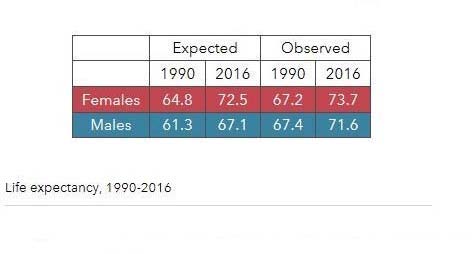
Most notably, throughout the years, the Honduras' government has made significant improvements to the public health system. In Figure 1
5. c) Alzheimer's and Dementia Efforts in Honduras
Due to the increase of neurological diseases surging in developing countries, such as Honduras, there is a limited number of trained neurologists caring
The Challenges of the Elderly Population with Alzheimer's and Dementia in Honduras
The Institute for Health Metrics and Evaluation) From the population totality, about 55.5% reside in rural areas and 44.5% in urban areas. Moreover, 47% of the population is 18 years of age while adults older than 60 years of age represent 5.7% of the total population and are the most vulnerable group. According to Pan American Health Org (2017, p. 169), from a socioeconomical perspective, Honduras' elderly tend to suffer more due to their declining health condition. Additionally, about 46% lack formal education of which 79% do not have social security. Also, about 44.5% of for patients (Medina et al., 2007). In collaboration with the Honduran Security of Health, the National Autonomous, University of Honduras (UNAH), a Neurology Department within the University system was established to increase the number of the country's neurologists. Over the years, period covering 1998 - 2006, a 31% increase in the number of neurologists in the country was reported (Medina et al., 2007). Though there have been improvements made to reducing morbidly and mortality of neurological outcomes, there is still room for improvement.
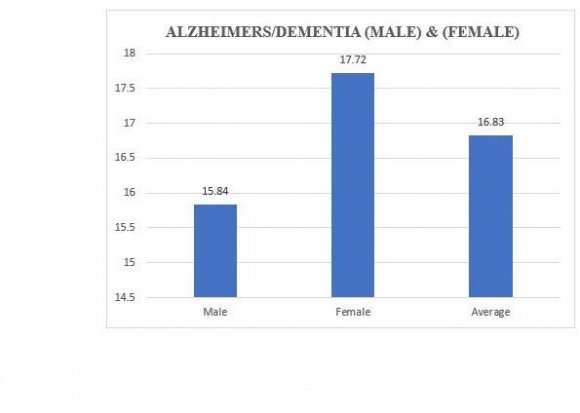
The World Life Expectancy (2017) website reports the totality of Alzheimer's and Dementia deaths under one category heading entitled Alzheimers/ Dementia.
Graph 1 reports the death rate per 100,000 among Alzheimers/Dementia patients residing in Honduras. Accordingly, the following were reported: Females at a rate of 17.72 as compared to Males at a rate of 15.84 with a total average combined rate of 16.83 and the country being ranked 101 among other countries globally.
6. Conclusion
Honduras has made considerable changes to governance and public health policies over the years. In the 1990s, Honduras championed a reduction in maternal mortality rates, but due to their social, political, and economic factors, it drastically prohibited the country from progressing in other relevant public health policies (Johnson, 2010, p. 11).
There seems to be a disconnection among public health outcomes for the elderly population. Most of the seniors reside in the rural areas and most do not have a formal education and are unable to take care of themselves. Moreover, most of the elderly services are situated in urban areas and; therefore, are unavailable to others who reside in the rural areas of the country.
Over the years, a dramatic increase in the number of Alzheimer's incidences has been observed. It is critical that the Honduras' government review current public health policies and include elderly short/long term assistance. The Honduras' government should make a consorted effort to improve public health polices, particularly for those who are unable to support/fend for themselves and rely on a family member(s) for assistance.
IV.
7. Recommendations
Studies have suggested an increase in the number of the elderly population (older than 60) in Latin America in the upcoming years, which will result in a surge of Alzheimer's incidences (Nitrini et al., 2009). This is consistent with the number of Alzheimer's Most importantly, Honduras can consider renewing public health policies to solidify epidemiology efforts. By doing so, it can gear up for the future in the event of an upturn of Alzheimer's disease incidences, particularly in the rural areas reported.
Additionally, Honduras should consider other steps to improve medical outreach programs for the elderly residing in rural areas, like Japan's innovative Kakaritsuke program.
In 2012, the Japanese government established the Kakaritsuke physicians program. The Kakaritsuke are not practicing physicians, but rather general practitioners who mostly practice in rural areas to deal with the elderly population. The Kakaritsuke physicians are limited to only advising patients on how to stay fit/healthy and to make sure they stay active (Japan renews primary health care to promote healthy aging, 2018). This program has led to the improvement of medical outreach among the Japanese elders, particularly those with Alzheimer's disease.
In short, should the recommendations be considered, it will afford the Honduras' government an opportunity to rethink their public health policies in preparedness for the influx of Alzheimer's disease patients in the future.
| Abstract-The purpose of this paper is to analyze the number | |
| of Alzheimer's and Dementia incidences occurring in | |
| Honduras and afford recommendations to improve public | |
| health policies to assist the elderly. According to The Institute | |
| for Health Metrics and Evaluation (2016), there has been an | |
| increase in the number of Alzheimer's incidences in Honduras. | |
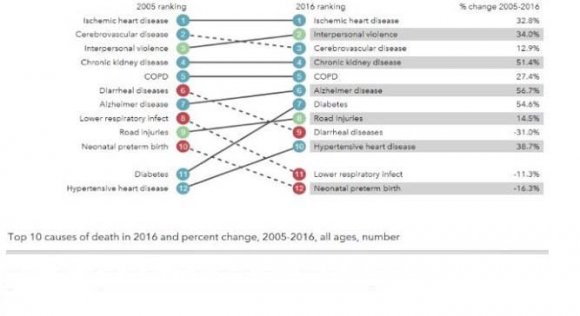
| Moreover, the number of Alzheimer's cases has increased by | |
| 51.4% from 2005-2016. The findings suggested that the | |
| country needs to consider a reevaluation of public health | |
| policies to tackle the influx of Alzheimer's incidences in the | |
| upcoming years. Though the elderly population stands at a | |
| little less than 6% of Honduras; total population (Bermúdez- | |
| Madriz et al., 2011), it is critical that the elderly community be afforded the best possible healthcare services available. | 1. Alzheimer's Disease: Patient has difficulty |
| Research suggests that most of the elderly community reside | communicating with others, experiences mood |
| in rural areas where minimal healthcare services are available. | changes and personality changes, and is unable to |
| In the end, the recommendations will be afforded for the | reason as well as other neurological symptoms that |
| improvement of public health policies to assist the elderly and preparedness for the surge of Alzheimer's disease in the country. | may occur (McKhann et al., 2011). 2. Vascular Dementia: Results in urinary frequency more often than regular occurrences (Sakakibara et |
| al., 2012). | |
| 3. Frontotemporal Dementia: An individual may | |
| experience mood swing changes as well as trouble | |
| communicating verbally (Bang, Spina, & Miller, | |
| 2015). | |
| 4. Dementia with Lewy bodies: Resembles Parkinson's | |
| disease resulting in visual hallucinations and | |
| sleeping disorders (Walker, Possin, Boeve, & | |
| Aarsland, 2015). |
| resources from the Honduras' government, it is |
| challenging to afford the general population with |
| adequate healthcare coverage (Carmenate-Milián et al., |
| 2017). |
| According to The Institute for Health Metrics |
| (2016), Honduras' population is about 8.3 million from |
| 8,045,990 million reported by Bermúdez-Madriz et al. |
| (2011) and Honduras, Encuesta Permanente de |
| Hogaresde Propósitos Múltiples (2009). |
| Year 2019 |
| ( ) G |