1. Introduction
nleashing the secrets of being a successful leader has always been a favourite topic among researchers and managers within the business communities. There is extensive amount of research available about the positive leadership styles and also characteristics. Shelves in the bookstores are full of books containing hints and tips of successful leadership; often focusing on the qualities and behaviors of good leaders and managers. Even though some scholars argue that such theories are to blame for existence and rise of immoral and greedy management practices today (Ghoshal, 2005); there is no shortage on the demand and interest for studies in this area of research, and publications.
In recent years, we have seen a surge in the studies investigating negative leadership behaviors and practices, instead of traditional focus on positive behaviors of leaders to achieve the desirable outcomes (van Fleet & Griffin, 2006). Scandals like Enron (BBC, 2002), Tyco (NBC, 2005), Freddie-Mac (New York Times, 2003) or AIG (Bloomberg, 2005) clearly showed the consequences of bad management practices employed in businesses. Similarly, 2008 financial crisis, from which the world is still trying to recover, is considered to be a result of mismanagement of top corporations, especially in the financial industry (The Guardian, 2011). All these scandals and crisis pulled the attention of the researchers into investigating dysfunctional management practices.
By definition, dysfunction is an abnormality or impairment in the function of a system (Oxford, 2015). In the context of organizations, it refers to the situations, where an organization does not operate within the normal levels of output and produces, often U unexpectedly, lower quality or quantity of products or services.
Dysfunctional behavior is defined as "any behavior that brings harm, or is intended to bring harm, to an organization, its employees, or stakeholders." (Giacalone & Greenberg, 1997; quoted in van Fleet & Griffin, 2006).A leadership style employing such features is called a dysfunctional leadership. Dysfunctional leadership is also called toxic or destructive leadership in the area of research. Lipman-Blumen (2005) describes such leaders as "those individuals who, by virtue of their destructive behaviors and their dysfunctional personal qualities or characteristics, inflict serious and enduring harm on the individuals, groups, organizations, communities and even the nations that they lead". One of the best definitions of destructive (dysfunctional or toxic) leadership is given as "the systematic and repeated behavior by a leader, supervisor or manager that violates the legitimate interest of the organization by undermining and/or sabotaging the organization's goals, tasks, resources, and effectiveness and/or the motivation, well-being or job satisfaction of subordinates" (Einarsenet al., 2007).It is estimated that around 8-10% of all leaders are toxic (Ulmer, 2012; quoted in Whipple, 2012).
The behavioral set of a toxic leader is also often referred as the "dark-side of leadership" (Conger, 1990). There are a lot of behaviors or practices that can be observed as part of the dark side. Gabriel (2013) states authoritarianism and narcissism as the most common types of dysfunctional leadership. Other scholars also add, abusive supervision (Tepper, 2000), and unpredictability (Schmidt, 2008) to the classification. Before, we go on explaining those, I would like to add also Machiavellianism as a commonly observed toxic leadership behavior to the list.
? Authoritarianism is a behavior often associated with tyrants like Hitler, or Stalin. However it is not limited to the area of politics, and commonly observed in the business environment. Authoritarian leaders command and tell other people what to do, and often how to do it. They offer to employees, limited autonomy and space for personal creativity. They tend to lead the organizations in a rigid hierarchical structure, with no flexibility. They are usually quick tempered, with little tolerance to failure. They demand absolute obedience from subordinates and penalize the ones acting otherwise. They do not
2. Global Journal of Management and Business Research
Volume XIX Issue I Version I Year 2019
3. ( )
A manage on the floor with limited direct interactions with subordinates in lower ranks. Due to this, they lack input from the employees and they make quick decisions with often incomplete or inaccurate information, only shared with their small circle of trust. Authoritarian leaders lead an organization by fear instead of influence and inspiration. An organization with an authoritarian leader, demonstrates a culture of force, fear, rigidity, lack of flexibility and intolerance to failure. Interestingly, authoritarian leaders often reach to a wide, loyal, supporter group, due to psychological needs for a "father figure" (Gabriel, 2013). Even though short term wins are often observed due to quick actions taken, in the long run, authoritarian leaders often dismantle the organizations, lose the talent, and make the company worse off.
? Narcissism is considered to be one of the most offensive forms of non-pathological human behavior (Paulhus & Williams, 2002). As narcissists have huge admire for their selves, they show little attention or attribute little value to opinions of others. They may be blinded by their self imposed glamour and egocentricity, and may lose touch with others and the reality. Narcissist leaders "are generally motivated by their needs for power and admiration rather than empathetic concern for the constituents and institutions they lead" (Rosenthal & Pittinsky, 2006). They may act as "Pyrrhic Victors" as Conger (1990) explains in "The Dark Side of Leadership" as they believe in their vision over anything else; they may consume excessive resources under a deluded perception of achievement created by an initial success. Under the supervision of a narcissistic leader, organizations demonstrate an excessive focus on creativity and glamour with lack of execution and results (Gabriel, 2013) (Post, 1993), majority view it far more than an extreme form of self-esteem and consider it harmful or potentially dangerous.
? Abusive supervision is defined as "subordinates' perceptions of the extent to which supervisors engage in the sustained display of hostile verbal and nonverbal behaviors, excluding physical contact" (Tepper, 2000). Even though Tepper described it as a form of authoritarian behavior, and is often preferred by authoritarian leaders, abusive behavior can also be displayed in a subtle form as bullying, retaliation, or injustice.
? Unpredictability of a leader can be a reason for stress and discomfort among the employees. Most of the research on the dysfunctional leadership area assumes a leader to act in a certain way consistently, even if it is a toxic behavior (Schmidt, 2008). However, in reality, some leaders swing between the moods and behavioral traits inconsistently, making it very difficult for subordinates to prepare and react in certain ways.
Inconsistent messages delivered by a dysfunctional leader, create ambiguity and confusion. It becomes difficult to prioritize tasks and eventually organization starts operating in suboptimal efficiency.
? Machiavellianism is also considered as part of the "dark triad" of personality (Paulhus & Williams, 2002). It is described as "aggressive, manipulative, exploiting and devious moves in order to achieve personal or organizational objectives" (Calhoon, 1969; quoted in Hunt & Chonko, 1984).For a Machiavellian leader, "the ends justify the means" (Deluga, 2001); as such they pursue achieving their goals at all expenses, even if they include a variety of immoral, unethical or illegal ways. They show little or no care in rules, traditions or practices, if they divert them out of their way to achieve their goal. Aforementioned scandals include numerous examples of such dysfunctional leadership practices. Machiavellian leaders can also often show authoritarian and narcissist behaviors.
Values and vision of a leader is reflected into the culture of an organization (Trice, 1988cited in van Fleet & Griffin, 2006). Organizational culture is the identity that holds the organization as a single entity against external forces; it represents the values, goals and purposes of an organization (Goffee and Jones, 1996). Organizational culture evolves over time and shapes the behavior of existing and new members of an organization (van Fleet & Griffin, 2006). Goldman (2009) says that toxic leaders represent an example of "perpetuating dark side hubris and narcissism" that impacts the organization negatively. Such organizations become dysfunctional by being less efficient, under performing and less effective relative to their peers (Balthazardet al., 2006).
4. Global Journal of Management and Business Research
Volume XIX Issue I Version I Year 2019 ( ) A Tavanti (2011) argues that an organizational culture that has heavy focus on results, without any attention on progress to get there, actually encourages dysfunctional leadership behaviors. In order to prevent such behavior in an organization, he recommends changing the performance evaluation criteria of a leader from being based on achievement of financial targets, to a combination of the results and quality of interaction with their subordinates and stakeholders.
It is important to spot dysfunctional behavior of a leader as early as possible, before discontent and toxicity is spread to the organization. Such leadership behavior may show some earlier signs, such as; inadequate attention to employees, driving an agenda of self-interest and declining organizational climate due to conflicts in relations (Reed, 2008). If that's not done, consequences of dysfunctional leadership can be huge, even well beyond the organization and the firm itself.
Dysfunctional leaders tend to be distant and disconnected from their organizations. They are not very visible and accessible by their subordinates. They rely on their close circle of managers and consultants in making decisions and lose their connection with reality. Lack of input from the employee floor, brings about difficulties in capturing customer needs, issues and priorities. In a dysfunctional organization, employees do not share their opinion with freedom and confidence. They do not take risk or initiative, due to fear of retaliation. Avoidance of taking risk, limits the innovation and creativity. Especially in a fast-changing industry like technology or finance, this may create stagnation, and delay in adapting changing trends.
Dysfunctional leaders are usually very demanding and they do not like to hear failure. As achieving results are highly valued, a culture of egocentric self-promotion, artificial success and conversations with hidden agendas, is created. People start claiming on others' successes and fight to step on each others' shoulders to climb the corporate ladder. This diffuses corruption, greed, collusion, internal competition, acute malice and hostility into the organization. Equality and fairness disappears. In 1998, top management partner of the former accounting firm Arthur Andersen, Steve Samek, introduced the 2X rule, mandating each partner to generate 2-times the revenue from businesses outside their primary the scope of work (Wall Street Journal, 2002); this created intense pressure in the organization for malicious activities and no wonder resulted in scandals like Enron.
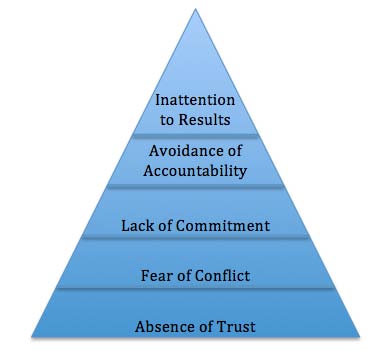
In a dysfunctional organization, subordinates feel oppressed, constantly under threat, emotionally drained, and not valued. Intense pressure triggers internal conflicts and creates an unhealthy working environment with lack of trust and collaboration among members. In his famous and widely adopted organizational leadership book "Five Dysfunctions of a Team" Lencioni (2002) argues, if trust is not established among the employees of an organization, it demonstrates itself with absence of healthy conflict and commitment and results with lack of accountability and results. As such, in his famous pyramid of dysfunctional teams, he puts absence of trust as the foundation of the pyramid. This simple and effective model is proven to be very popular among the leadership communities for many years (Figure 1). Dirks & Ferrin, 2002). To build trust, along with ability; benevolence and integrity should be displayed (Mayer et al., 1995); both of which might be non-existent in a toxic leader.
Leaders, not only can be a source of toxicity, but also effective leadership can help organization deal with the damaging levels of it (Frost, 2003). Dysfunctional organizations need guidance, coaching, and close attention of a good leader to correct themselves. However, a dysfunctional leader may turn a blind eye, or may be completely oblivious to what's happening in the organization. When that happens, followers of a dysfunctional leader feel deceived and misguided; they disengage, take minimum responsibility and avoid accountability. Such organizations do not fail only in results, but they eventually lose their unity, dissolve and drive away talented individuals.
In conclusion, there are many studies conducted about dysfunctional leadership behaviors and their impacts on the organizations. A leader shapes the culture of an organization. Dysfunctional leadership styles (authoritarian, narcissist, abusive, unpredictable, Machiavellian), may prove to be effective in the short term and may create some quick results, however in the long run, they disrupt the organization negatively and change the culture for the worse. Organizations with toxic cultures would have very little to offer to the talent, required to drive results and growth. As a result, they cannot survive in a competitive market environment. It is crucial for an organization to spot the signs of dysfunction as early as possible, and take action to mitigate such consequences.