1. Introduction
he megatrends refer to transformative forces which define the future scenario of the world with impact on economies, business and personal lives to 2050 and beyond. These megatrends have a very high impact and power to change both a large city and a single individual. For any company's future strategy, development and innovation process a detailed analysis of megatrends and their inferences is a major component that should be taken into consideration at any stage. In recent years, the digital technological development and their far-reaching implications have brough us to a point where technological megatrends are really reshaping our world and our way of justification in decision making. In this paper, I have selected three technological megatrends: Artificial Intelligence (AI), Big data and Block Chain and analyzed their future prospects in the technological world.
Artificial Intelligence (AI) refers to the ability of a machine to simulate human intelligence and is done by a set of processes. According to William F. Clocksin in 2003, Artificial Intelligence is the section of computer science which focuses on machine equipping with perceptual and reasoning abilities. In another sense It is the ability of a digital computer or a robot controlled by computer to do tasks which is commonly done by intelligent beings (B.J. Copeland, 1998). As people of are looking to shorten the processing time of every tasks, at some point in future people may be replaced with machines and AI might be able to learn faster than humans, thus the impact will be like exponential growth ( Peter Fisk, 2019). According Clifford G. Lau & Brian A. Haugh (2018) the application of Artificial Intelligence(AI) to autonomous systems(AS) has emerged as a megatrend that is expected have definite and wide range of influences on future human society. What makes artificial intelligence (AI) a megatrend is its recent advances in applications as self-driving cars, smart personal assistant, image-video and game playing have captured not only public imagination but also governments, industries and militaries across the globe. With AI from recent demonstrations it can be seen that AI systems will perform task like human intelligence. (Clifford G. Lau & Brian A. Haugh, 2018) Big data refers to data which is huge in size with great diversity and with exponential growth with time that is very complex that none of the traditional data processing or management tools are able to process or store it (C.L. Philip Chen & Chun-Yang Zhang, 2014). A more detailed definition by Gartner was given in 2012: Big Data are high-volume, high-velocity or a high-variety information asset that need newer processing forms to enable inflated decision making, insight discovery and process optimization. In general sense, the data set is a big data if it performs visualization, capturing, curation, and analysis on it at the current technologies (C.L. Philip Chen, Chun-Yang Zhang, 2014). Big data is a novel term that originated from the need of large companies, such as Yahoo, Google, and Face-book, to analyze large amounts of data (Garlasu et al., 2013). There is no doubt that big data a genuine and intrinsic value and if the value is discovered properly it can have a profound impact on the decision making of the organization.
According to Waal-Montegamy, 2016 the volume of the worlds data is expected to grow by 40% per year and 50 times by 2020. According to published news in The Science Daily 90% of today's data was generated in last two years (Science Daily, 2016). Khan et al. 2014 stated the market value of big data in 2010 was $3.2 billion, and this value was expected to increase to $16.9 billion in near future. Thus, is can be T clearly predicted that big data will have an exponential growth over last 10 years which will immensely affect the company's decision making in not only operating current businesses but also to invest in new business ventures and thrive in a world of constant changes. Big data has many important application in today's world such as technology: reducing processing times from hours in seconds, health: DNA mining, discovering and monitoring health issues, Smart cities: Wise management of natural resources for sustainable economic development (Wei Fan & Albert Bifet, 2016). Big data is no longer just a marketing department slogan and is immensely becoming vital part of business IT strateigies. Data of today in its unstructured formats is very difficult to manage and maintain for companies hence the companies are making strategic data and analytics plans parallel to the business growth plan (Lalit Dhingra, 2019). According to Lalith Kumar Dhingra in 2019, Big data helps critical business decision and almost all companies especially in online business big data will be a regarded as a mainstream practice.
A block chain is a transaction ledger which is validated by a large network of computers and information stored in blocks and linked in such a way that any changed in blocks will make all future blocks invalid making it safe, secured and verified( Daniel Mullins, 2019). According to Quoc Khanh Nguyen (2019), block chain is a digitalized system of accounting records consisting of detailed transactions based on a mathematical set of rules to block any illegal interference. According to research it has been shown that, decentralized ledger and Blockchain are potentially powerful tools to minimize costs and bring major changes to the financial field in long term (Nguyen, 2019).
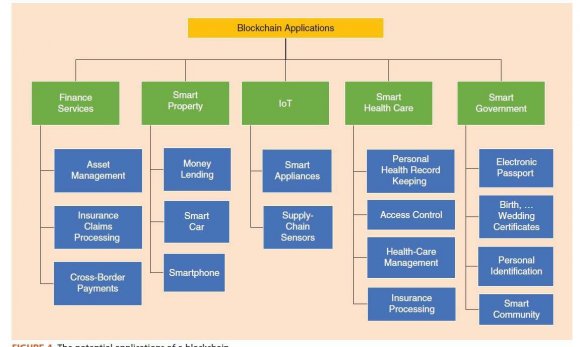
According to an article published in digital pulse in 2018, businesses from different industries are investing in the development of applications utilizing block chain in such extent that the technology is expected to generate US$3 trillion by 2030( Digital Pulse,2018). The block chain came to the knowledge of the public as a key technology behind bit coin but its potentiality has grown and is seen to be growing in such a way that it would become inevitable in all electronic transactions weather making payment online, brokerage activities online or even identity verification to government. In recent times, Bitcoin often regarded as the first crypto currency has enjoyed a huge success with the capital market reaching 10 billion dollars in 2016 (coindesk, 2016). The allowance of finishing payment without any bank or intermediaries, blockchain can be used in many financial services such as digital assets, remittances or online payments (Peters et al., 2015;Foroglou and Tsilidou, 2015). Furthermore, blockchain technology is becoming one of the most promising technologies for the next generation of internet interaction systems, such as smart contracts (Kosba et al., 2016), public services (Akins et al., 2013), internet of things (IoT) (Zhang and Wen, 2015) and security services (Noyes, 2016a). According to an IDC report, the financial services sector was the topmost investor in blockchain technology in 2018 ($552 million). There is no scope of doubt blockchain will play an enormous role in bringing changes in the way we do our transactions and way we do activities online. The growth of this technology till now is in such a great extent that it is clearly regarded as a major technological megatrend for next 10 years of the world.
2. II.
3. Trend Reflections a) Artificial Intelligence(AI)
In most people mind while hearing about Artificial Intelligence the first thing that comes is Robot: the reason for that is the big-budget films and novels make stories about machines like humans that wreak havocs on earth( Jake Frankenfield,2020). An easy way of defining AI is that, its is based on a principle that human intelligence can be defined in such a way that it is mimic able and excitable easily by machines. AI works by the combination a big set of data with fast, constant processing and unique algorithms which allows the automatic learning of the software from the features and pattern of the data. Artificial intelligence generally falls under two broad categories: 1. Narrow AI. 2 Artificial General Intelligence ( AGI)
Narrow AI also referred to as ''Weak AI'' operates within a limited context and is a simulation of human intelligence. The machine under Narrow AI operates under far more constraints and limitations than human intelligence is focused on doing single task in perfect manner (Source: builtin, 2019). Few examples are: Google searching, image recognizing software, Siri, Alexa and other similar personal assistance, self-driven cars et.
Artificial General Intelligence (AGI): AGI, sometimes referred to as "Strong AI," is the type of artificial intelligence we see in the movies and is a machine with general intelligence with much similarity to human begins. It can solve any problem through the application of certain intelligence.
4. III. Current Predictions About Future
Impact of Artificial Intelligence (ai) According to Clifford G. Lau & Brian A. Haugh in 2018, Artificial intelligence (AI) will enable autonomous systems (AS), with far-reaching implications in both the civilian sector and defense. Autonomous system refers to the machines that operate without the active intervention of a human operators: the technologies used in AS often include sensors, computers, and AI (G. Lau & A. Haugh, 2018). The author also stated, The robots with AI system will perform difficult and dangerous tasks that require intelligence like humans, Automobile transport system will be revolutionize by self driven cars and traffic congestion will be reduced and big data analytics using AI techniques will make humanlike decisions to improve governmental social services, health care, criminal justice, and the environment. According to an article published in Scoro (2019), it has been predicted by Ray Kurzweil that computers will have the same level of intelligence as humans by 2045, this is called singularity by some scientists (Scoro, 2019). With the big data techniques, AI will be capable to analyze huge amounts of information and come up with solutions to biggest global problems such as hunger, diseases, climate change and excessive population growth (Liisi Ruuse, 2019). As humans and machines collaborate more closely, and AI innovations come out of the research lab and into the mainstream, there is staggering possibilities of transformation (Source: pwc) According to PwC, 7 million existing jobs will be replaced by AI in the UK from 2017-2037, but 7.2 million jobs could be created.
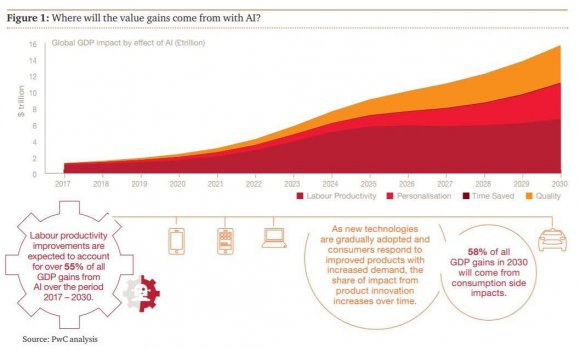
According to the analysis of Pwc, global GDP will be up to 14% higher in 2030 as a result of the accelerating development and take-up of AI-the equivalent of an additional $15.7 trillion. The driver of this impact will be 1. Productivity gains from automation process in business (use of robots and autonomous vehicles). 2. Productivity gains from businesses from existing labour force augmented by AI. 3. Increased consumer demand due to higher availability of AI enhanced products and services (Source: pwc) From the above figure published by pwc, the most impact on global GDP by the effect of AI will be measured by Labour productivity by 2030 which includes the automation of routine tasks, augmenting employees capabilities and freeing them up more for stimulating and working with high value addition(Source: pwc). Personalization of products by customers will be made even more easy to make by the interventions of AI technology.
According to the analysis of Pwc Some of the most notable impact of AI in healthcare would-? Supporting diagnosis in areas such as detecting small variations from the baseline in patients' health data or comparison with similar patients.
? Early identification of potential pandemics and incidence tracking of the disease to avert and minimize the extent of its spread ? Imaging diagnostics (radiology, pathology). introduced Artificial Intelligence in making their Audit judgements (Omoteso, 2012). AI techniques has produced huge waves across healthcare with an active discussion weather AI doctors eventually be a replacement of human physicians in future. states AI will definitely be assisting physicians for better clinical decisions, may also replace human judgement in certain areas of healthcare (e.g. radiology) but will not replace human physicians (Fei Jiang et. al, 2017). According to Barnarrd Marr (2019), with better monitoring and diagnostic capabilities, artificial intelligence can dramatically influence healthcare by improving health care facilities medical organizations which as a result can reduce operating costs and save money. One estimate from McKinsey predicts big data could save medicine and pharma up to $100B annually. Potential for personalized treatment plans and drug protocols as well as giving providers better access to information across medical facilities to help inform patient care will be life-changing (Marr, 2019). Our society will have huge increase in job productivity by the introduction of autonomous transportation and AI influences in traffic congestion issues.
5. One of the first area of business in which
In the area of financial services AI will have a big impact according to the analysis of Pwc. Three areas of financial services are-? Personalized financial planning.
? Fraud detection and anti-money laundering ? Process automation -not just back office functions, but customer facing operations as well.
According to Ai specialist of PwC in retail areas AI will have such impact which will allow retailers to use deep learning to predict customer needs and proper inventory and delivery management(Source: PwC). In transport and logistics with the usage of AI technology traffic congestion could be made under controlled and without any barrier to transport logistic services would be more efficient (Source: PwC).
Complex situations are characterized by an absence of elements or variables. Over recent year, with AI's capabilities of doing quantitative, computation and analytical tasks has surpassed human beings in doing works with complexity (Jarrahi, 2018). With the assistance of comprehensive data analytics more effective ways of human decisions equipping has been possible which opened up opportunities for dealing complexity in decision making. Thus AI in future can help to reduce complexity by identifying causal relationship among many possibilities in a acertain scenario through causal loops (Marwala, 2015). Professor Spyros Makridakis in his article in 2017 stated, with the widespread usage of AI inventions People will be capable of buying goods and obtaining services from any part in the world with the usage of Internet, and exploiting of the unlimited additional benefits.
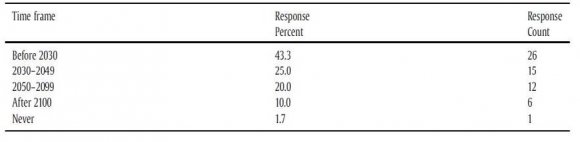
According to Kurzweil's prediction, computers will reach human intelligence around 2029 (Kurzweil, 2005) while Singularity will come by 2045. In 2009 Barrat and Goertzel (2011) asked the participants of an Artificial General Intelligence (AGI) Conference to answer the question: "I believe that AGI (however I define it) will be effectively implemented in the following timeframe". The answers those were given by 60 participants are given below:
6. Source: Professor Spyros Makridakis, 2017: The forthcoming Artificial Intelligence (AI) revolution: Its impact on society and firms
According to the prediction of Spyros Makridalis (2017), The technological change from the forthcoming AI revolution will open huge opportunities for growth and profitability but also new challenges and competition from new start-ups as breakthrough ideas can come from anywhere and with crowd sourcing and venture capital their development their development and financing will be easier ( Makridalis,2017) According to the critics, the fear that is present in their prediction is the fast growth of job obsolescence through AI technologies especially in service sector (Makridalis (2017). According to the New Yorker (2016), While it took three to four decade to see the impact of digital technology it might be no more than a decade until all of us observe the full effect of AI revolution. According to PBS (Thoet, 2016) the newly announced Amazon Go retail store, using AI technologies to abolish employees, "could drastically change the way people shop and eventually eliminate the need for millions of workers, according to the prediction of industry experts.
A future utopian scenario of Artificial Intelligence could be an instant transfer of certain technological skill to another human being which in today's world we only can do with training and practice within a time frame.
The AI intervened chip in human body could be another state of perfection where medical doctors can monitor their patients 24/7 and analyze their physiological condition for better treatment. The patient will no longer be visiting medical clinics but get anything they want from home. A world of complete cyber security where AI will protect all data of all the people and can track and trace any harmful activity from anywhere in the world which confirms a secured life without terrorism or cyberattacks.
7. a) Suggested measures for Business to create higher value through Artificial Intelligence
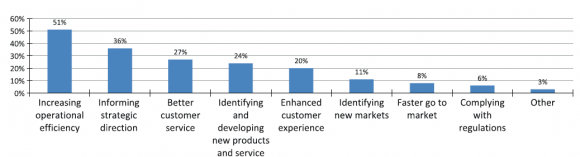
The business in the future can increase their operational efficiency in a great extent through the usage of Artificial Intelligence (AI). Therefore, correct implementations according to requirement is an important issue. For example, in business it will be possible to process invoices by proper using of speech recognition applications to take necessary notes loudly, thus, it can provide the advantage of transcribing notes without having to work much on note taking activities Businesses should focus more on automation of every process through the applications of Artificial Intelligence which in turn can provide the opportunity to increase processing time and cost minimization. When the businesses make use of software applications powered by AI, they will be able to increase automation at the business level which enables to run the business process efficient and time is saved from investing in manual labor.
The businesses should also focus on implementing AI techniques along with big data analytics. With the availability of big data analytics decision making and AI process implementations can be more efficient for business growth in future.
8. IV.
9. Big Data
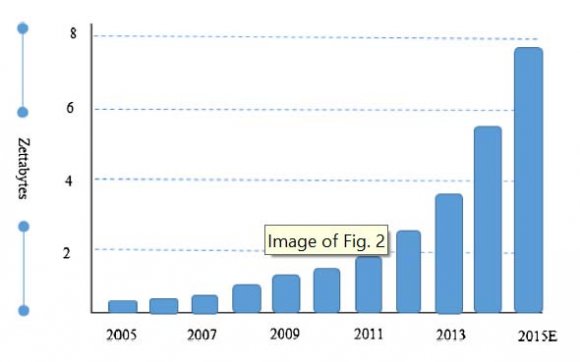
Since the invention of computers, data generation has been taking place at a fast rate which ultimately has worked as a key motivator for current and future research frontiers (Ibrar Yaqoob et. al, 2014). Technological advancement in mobile devices, digital sensors, communications, computing, and storage have created the means to collect data (Bryant, Katz, & Lazowska, 2008). The novel term Big data came from the need of analyzing large amounts of data by big companies like Yahoo, Google and Facebook (Garlasu et al., 2013). The renowned IT company Industrial Development Corporation( IDC,2011) stated there has been increase of nine times in the total amount of data in the world (Gantz & Reinsel, 2011) and the figure is expected to be doubled in every tow years at a minimum (Chen, Mao & Liu, 2014). Doug Laney with Gartner described big data with three aspects: volume, velocity, and variety. The term volume refers to the size of the data, velocity refers to the speed of incoming and outgoing data, and variety indicates the sources and types of data (Philip Chen & Zhang, 2014). Veracity or variability have been added by IMB and Microsoft as the fourth V in the definition of big data. The term veracity refers to the messiness and trustworthiness of data.
The author Can Yortseven (2019) his persepective of 3 V (Volume, Velocity and Variety) of big data in an article in Deloitte as following: The volume of data simply refers to the fact that, within the big data platforms the volume of data can be bigger than the volume size of data in a traditional data management systems. The velocity of data refers to the fact that Big Data platforms are able to process both data-in-motion means streaming of data which can be retrieved from live happenings and data-at-rest (e.g. reporting layer fact-dimensions). The variety of data refers (e.g. structured data, weblogs, sensor data, video etc. (Yortseven, 2019)
V.
10. The Current Trends and Opportunities in big Data
According to research, the growth of big data has taken place at a rapid rate and in the Waalmontgomery in 2016 it was stated that big data will grow by 50 times in 2020 (Ibrar Yaqoob et al. Starting from internal insights to front-facing customer interactions there are enormous growth opportunities by big data applications in business. Three major business opportunities include: automation, in-depth insights, and data-driven decision making.
Automation: Robotic process automation can foster the improvement of internal efficiencies and operational ability by the business organization. The immediate analyzing of a huge amount of real time data can make big influence in automated decision making for the business Automated data collection and storage will also be very affordable with scalable IT infrastructure and lower cloud computing costs.
11. Discovery of hidden insights:
The hidden opportunities in business can also be uncovered by the usage of big data and the scope to review large set of data. Complex data sets can even be used to develop new products or enhance existing ones. Significant market data captured can prove to be invaluable.
12. Faster decision making:
With the fast processing time of data analytics and the ability to analyze new sources of data, instant analyzing of information by business has made them able to make smart and informed organizational decisions about new business strategies.
13. Big data in healthcare:
The real time analysis of healthcare data can result in improving medical services to the patients. Responses according to different patients to different drugs can highly pharmaceutical companies on drug development.
In fact, with the availability of large set of data pharmaceutical companies with the analysis of the data can personalize medicine for each patient and ensure faster and better recovery (Yaqoob et al., 2016). With the technologies for large set of data content optimization, classification and organization can be possible in web based medical treatment from where the patient can be highly benefited while searching for specific treatment.
Big data in logistics: Delivery optimization will be highly possible for companies as they take data from GPS trackers, telemetry systems and traffic monitoring services and can analyze them to make real time decisions (Source: itransition,2019). Inventory management is also possible in efficient manner by demand analyzing per customer segments or specific periods thus the right anticipation of demand and avoiding over or under stocking inventory management can be done proper way.
14. a) Suggested measures for organization for future value outcome from Big data
Appropriate data infrastructure: As big data consist of very large amount of data sets which is complex, the organization depending on big data analysis on their strategy formulation should have the adequate capability of holding complex data with right network, data storage and processing infrastructure. As the data will be unstructured thus the right way storing data is also important for future retrieval of data for analysis.
15. Cleanliness of data:
In a database mistyped, incorrect or poorly integrated affects overall decision-making process negatively thus it can affect organization performances and decision making. Data can also contain error by human mistakes. So, organizations should be critical to their data and check data validity by searching and fixing errors.
16. VII. Block Chain
The digitization of information can be facilitated by Internet of Things (IoT) in some means but the reliability issues of this kind information has been and still is a key challenge ( Ana Reyna et al., 2017). In this scenario the money transfer mechanism has been revolutionized by bitcoin which a crypto currency that can be transferred without financial intermediaries or foreign exchanges with the help of a digital wallet. This system is supported by a protocol that ensures that the information remains immutable over time and this protocol is known as Blockchain. (Ana Reyna et al., 2017). According to a an article in Computer world (2019), Blockchain has the ability to create secure, real time communication networks with partners around the work to support everything from supply chain to end payment to real estate deals and healthcare data sharing (Source:computerworld,2019). According to a research by ABI services blockchain has been having a solid adoption for application development and pilot testing good number of industries and likely to generate above $10.6 billion in revenue by 2023 and the revenue is expected to come from the sale of software and services.
The reason for blockchain to be regarded as one of the next technological megatrends can be justified by many prediction according to researches from big companies. According to prediction by Gartner, by the end of 2020, the banking sector will attain 1 Billion dollars of business value with the use of blockchain-powered crypto currencies and 55% of healthcare apps will be using blockchain for commercial deployment by the year 2025. Blockchain is also emerging as the perfect answer to the fight against Coronavirus by offering real-time tracking information, data immutability, and transparency across distributed decentralized ledgers (Srivastav,2020)
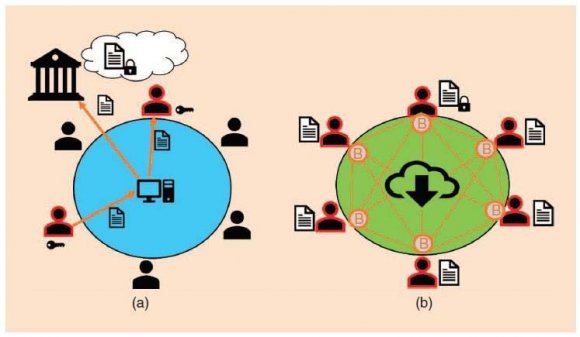
The three main advantages of Blockchain Technology for its widespread acclaim are Decentralization, Transparency, and Immutability. Before the invention of bitcoin and bit torrent we had a centralized entity, which refers to the interaction solely with the central entity to get required information. But in the decentralized system everyone present in the network owns the same information thus direct interaction is possible with another party without the use of third party thus bitcoin system through the protocol of blockchain make a certain person the only one in charge for sending his own money to someone.
17. System (Depak Puthal et al., 2018)
In blockchain a person identity is hidden through a complex cryptography and presented only through public address thus a person's real identity is secured which ensures transparency in the transaction.
18. a) Current Trends in Blockchain
Since blockchain had made its debut in the global stage finance was the first sector to take an interest and has been continuously buzzing with innovation and breakthroughs. Not only as virtual currencies blockchain can be used as fraud-resistant cleaning and settlement systems, smart contracts and can foster the digital transactions speed. (Bernard Marr, 2020). There is an undeniable worth of blockchain for any area of industry that requires transactions recording to be kept safe and secured and the activities can be carried out in a way that is traceable.
19. b) Launching of Facebook's digital currency
According to forbes, 2020, Facebook plans to unleash its own cryptocurrency on the world in the earlier period of 2020, and its already generating lot excitements and concerns even though many details are still yet to know. There have been a lot of crypto currencies in the past -well over 1,000 have launched since Bitcoin arrived in 2009, with the vast majority quickly sinking without trace. But none have been launched with the backing of a such a big organization like Facebook-a factor which could mean that the implications of this particular step go far beyond anything we have seen yet (Bernard Marr, 2020).
20. c) Combination with Artificial Intelligence
By combining the breakthrough technologies such as combining blockchain with AI, companies can make more quick and accurate predictions, minimize the waste generated in production process, streamline supply chains, and more quickly match new products and services in new markets.
21. d) Predicted applications of Blockchain in Business
Blockchain may be conceptualized as a DI, however, the practical application of blockchain still rather limited and the actual impact of this technological approach is yet to be seen ( Gareth R.T. White, 2017).
22. Financial services:
The emergency of blockchain systems such as Bitcoin (Nakamoto, 2008) and (hyperledger, 2015) has brought a highly notable impact on traditional financial and business services. Peters and Panayi (2015) discussed that Blockchain has the potential to disrupt the world of banking. Besides, there are real business cases like collateralization of financial derivatives that could leverage blockchain to reduce costs and risks (Morini, 2016). Large software companies such as Microsoft Azure (Azure, 2016) and IBM have also began to offer blockchain as a service.
Product quality assurance: For many organizations product quality assurance is a vital issue and there are Framework)
23. e) Suggested measures for businesses for greater value creation by Blockchain technology
The companies face a difficult task when deciding which opportunities to pursue as there are lot of use cases for blockchain. The companies can narrow their options through a structured approach thus the company should determine the availability of sufficient value for a certain case to implement blockchain technology for. It means the right choice of the case is important to predict which opportunities should be taken for organizational development through the use of block chain technology.
Every organization or business entity in future should create an active department for continuous analysis of the change on blockchain technologies. The department should collaborate with all other departments such as finance department, logistics department, marketing department and provide every department with latest data and trends according to market conditions. Thus, the companies should be able to adopt to any emerged standards.
Sing (2016) stated the device cost is decreasing and computing power is increasing day by day, therefore Blockchain presents an immense possibility in Internet of Things (IoT) and providing security. Therefore, there is no scope of doubt that with proper combination of blockchain technology and usage of IoT in businesses can open the door for immense opportunities for advancement and growth. So, the businesses should focus on the efficient applications of block chain and IoT in combination to get a sharp edge in their field.
24. VIII.
25. Conclusion
From the analysis and reflection of three selected trends ins this paper namely Artificial Intelligence, Big Data and Blockchain it is evident that all these technology are in the initial stage of development and has already marked their presence and importance in businesses. From various Research about these technological megatrends what has been found is that these trends are here and they will reshape our life in a great extent in next 10 years of time. The growth rate of this trend is far higher than any other technological development in the past. Big data analytics is undoubtedly the thing for next stage for business especially after the current pandemic of corona virus that we have experienced. The organizations already are quiet dependent on data analytics to make their decision regarding new investment or investing in current sectors. We can see how fast the need for data analytics have been growing in job sectors and this will grow more in next two years. Thus, a separate department for Big data analysis can prove to be impactful and specific consultants should be hired for certain techniques implementation.
Artificial Intelligence with the combination of Internet of Things (IoT) will have a profound impact on how the business works in the future. Through AI techniques implementation the organizations will be more automated and labor productivity will be much more higher although the fact of future job availability should be taken into concern. With AI technology the health care system can be improved in huge extent and treatment process can be enhanced in great way. Patient can be monitored at any time and correct monitoring of their health conditions can improve treatment. Another most notable megatrend is Blockchain which is also in its growth stage and will probably be the most secured way of communication and will be affecting the financial sector the most. As a decentralized system is maintained in blockchain, interconnection problems will be mitigated, and communication process will be lot faster and secured. In marketing sector blockchain will have its influence as product customization based on each customer needs will be lot more possible and customer satisfaction will also be enhanced through the application of this technology.